The owner's reeve · diligence for e-commerce acquisitions
Know what it's worth today. And what it's worth with you.
For PE firms, family offices, search funds and strategic acquirers. We rebuild a brand's economics from its own data: the earnings worth paying for, what the seller's numbers hide, and what the business can become under you, whether that's growth or a fix. In a deal, everyone wants it to close. You need one person who only wants you to get it right.
Fictional sample. Steps are the model's three scenarios at month 36. Multiples are placeholders until set from current market data for the deal.
01Two numbers for every deal
The price is one number. Your return is the other.
A seller's deck blends them: today's earnings, dressed up, plus value you would have to create. We separate them, so you pay for what's there and plan for what you'll build.
Number one
What to pay for
The business as it stands, with the seller's story taken out.
Earnings, from the source data
EBITDA tied to the target's orders, ad accounts and invoices; add-backs tested; owner pay at market rate. Alongside your accountants' QoE, not instead of it.
What customers and units really cost
Customer value from the order history, not the seller's LTV slide; unit cost from invoices, not the price list.
Earnings dressed for the sale
Ad spend cut before a sale lifts EBITDA while new customers quietly fall. Cohorts show it.
Concentration and contracts
One channel, platform, product, supplier or founder; who owns the ad accounts; notice periods.
So you don't pay for earnings that aren't there.
Number two
What you can make
The business under you: fixed, grown, and funded.
Leaks to fix after close
Each ranked by EBITDA and value: discounting, fees, fulfillment, products that lose money.
Growth its customers can pay for
What a customer can cost against what the brand pays, the first step, and how far it can go.
If it's broken: fixable or not
What to stop on day one, how much time that buys, and whether a different model would work.
Cash, scenarios and value
The cash each move needs, three futures side by side, and the value at exit.
So you don't pay the seller for value you'll create.
Sample brand C · customer value against cost, as presented and from its orders
3.6x 0.56x
The deck's LTV is revenue over three years. The orders give contribution over one. Same brand, same customers: one number says scale it, the other says it loses money on every new customer.
02A modelled example
Broken isn't always a no.
The best deals are sometimes brands that don't work yet. The question is whether they can, what it would take, and what that's worth paying today.
$9.5M in sales and a growth story in the deck. The seller shows customers worth 3.6 times what they cost. The orders show 0.56: every new customer loses money, and the brand loses $1.1M a year with seven months of cash.
Most buyers walk. Some should buy, at the right price, with a plan.
Reported: the seller's deck and the ad platforms. Real: the target's own orders and invoices.
Indicative value at month 36, three futures
Sample brand C is not a real target. It's a fictional brand we built and ran through our engine. Every figure is model output; the plan's levers are assumptions to test, not results. Values are indicative, with placeholder multiples. Profit eases in years two and three because the model holds prices flat while ad costs rise 5% and overheads 3% a year: any price rise is upside, not assumed.
03How we work
Screen. Diligence. Monitor.
Built around your deal timeline. Fixed fees, agreed before we start, and nothing tied to whether the deal closes.
01Screen
Before the LOI. Is it worth diligence, and if it's broken, is it fixable?
- From whatever the seller has shared
- Red flags, each with its effect on price
- A first read on growth, or on whether it can be fixed
Red Flag Screen
Rush in 3 days, +25%. Fee credited toward diligence on the same deal.
See the Red Flag Screen02Diligence
After the LOI. Both numbers, from 24 months of source data.
- What to pay for: earnings, customers, unit cost, risks
- What you can make: fixes, growth, cash, value at exit
- Alongside your accountants' QoE, not instead of it
Commercial Due Diligence
Reeve Live deal view from the day the data room is complete.
See due diligence03Monitor
After close. The value plan, tracked every week.
- Reeve Live on every brand you own
- Reviewed with your deal team, weekly or monthly
- Early warning when a brand drifts
Portfolio monitoring
Your operators do the work; we keep the numbers honest.
See portfolio monitoring04Reeve Live for deal teams
The deal, live. From diligence to exit.
Reeve Live switches on as soon as the data room is complete. During diligence it runs on the target's data: what customers are really worth, what units really cost, the leaks ranked by value and the forecast to month 36, updated as data arrives. After close it becomes the brand's monitoring.
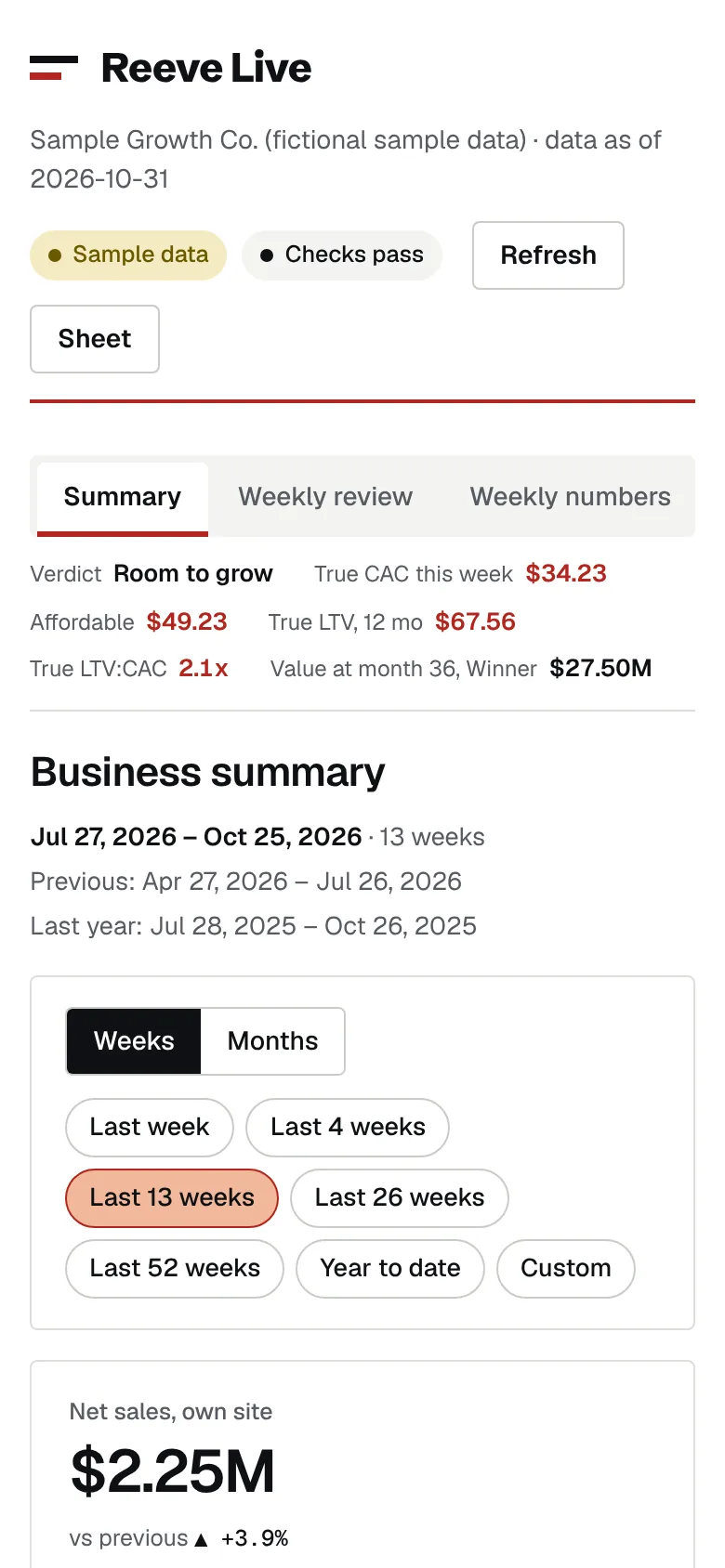
During diligence
- Both numbers, live as the data room fills
- Red flags raised in the weekly review as they're found
- Every assumption labelled, every check visible
- Shared only with your deal team
After close
- The value plan tracked weekly against reality
- Early warning when a brand drifts
- Each brand on the same dashboard; a deal-team view across brands is in development
- Your operators do the work; we keep the numbers honest
05Who we are
Twenty-five years on the operating side of commerce.
Wholesale, international trade, omnichannel retail and direct-to-consumer. We've launched and advised several brands selling into the US, Canada, the UK, the EU and Australia, so we know where a P&L hides its problems, and where a brand's real upside sits.

Founder
Hamed Derakhshan
Founded iCowhide in 2018 and built the brand from scratch to more than $36M in direct sales. Twenty-five years running operations and growth in e-commerce and home goods, with more than $66M in sales directed. Has helped launch several DTC brands past $1M. Computer science background; built Reeve's engine.
He has been the founder across the table: he knows which numbers a seller's deck flatters, because he spent years checking his own ad platforms against his bank account.
Why Reeve. On a medieval estate, the reeve was the owner's officer: he kept the accounts, held everyone who worked the land to what they had promised, and owned none of it. That is the job: on the owner's side, the numbers kept true, the work done by others.
Every part of the engine comes from something we got wrong, or watched someone else get wrong.
- Wholesaletaught usMargin is made or lost before a product ships.so in the engineTrue COGS is built from every invoice, not the price list.
- International tradetaught usFreight, duties, tariffs and exchange rates move margin more than most dashboards admit.so in the engineLanded cost covers every cost of getting a unit sellable, in every market.
- Direct-to-consumertaught usAd platforms report what flatters spend.so in the engineTrue CAC and true LTV come from your orders, not the ad dashboard.
- Omnichannel retailtaught usStore, ads, 3PL and accounting drift apart, quietly.so in the engineNothing reaches you until it reconciles to your books.
- Launching and advising brandstaught usThe same leaks turn up in brand after brand, market after market.so in the engineThe engine checks for every one of them, every week.
So we built the tool we always wanted: one model of the whole business, checked every time it runs, and independent of anyone who earns from your spend.
Independence
One side of the table, always.
- Never both sides of a deal.We don't diligence a company we advise, or advise one we've diligenced, before or after.
- Nothing tied to the close.Our fee is the same whether you buy, walk or renegotiate.
- Your findings stay yours.Buy-side work goes to you, not the seller, including what we see in its growth.
- Sourced, not asserted.Every figure traces to the target's own records; every assumption is labelled; every forecast comes with a confidence level.
- We never execute.We screen, diligence and monitor. Your operators do the work, so we never grade our own.
- Under NDA, end to end.Deal data is used for your deal only.
06Questions deal teams ask
Does this replace a financial quality of earnings?
No, and it isn't one. A financial QoE is your accountants' work, and lenders rely on it. We cover what it usually doesn't: customers, acquisition, operations and growth, from the target's own records. Most buyers use both.
Can you tell us whether a struggling brand can be fixed?
Yes. It's the question we're built for. We say whether it can work, what it would take, what to stop on day one, and what that leaves worth paying today. If it can't be fixed, we say so.
Who sees the findings?
You. Buy-side work never goes to the seller, and the Reeve Live deal view is shared only with your deal team.
Can you work to our timeline?
Yes. The Red Flag Screen runs in five business days, or three for +25%. Diligence runs about 30 days, with red flags raised as they're found, not at the end.
Do you ever work for sellers?
Not on a deal. We don't advise a company we've diligenced, before or after, and we don't diligence a company we advise.
Recommendation
Go, with conditions
Earnings
−$1.12M over 12 months; the deck leads with growth
Red flags
Growth bought with discounts · seven months of cash
Fixable?
Probably, with a different model · confidence medium
What to pay for
The asset floor, about $1.2M, plus funding for the plan
See the work before you call
A sample Go / No-Go memo.
On a fictional brand: the recommendation, the red flags with their effect on price, and a first read on growth or a fix.
Read the memo (PDF)Tell us about the deal.
Start with a free 20-minute call and an honest first read. We reply within one business day with fit, timing and a fixed fee. Happy to sign your NDA first.
How it works
- 01Pick a timeAny 20-minute slot that suits you.
- 02A few detailsFirm, deal size, stage and deadline. Happy to sign your NDA first.
- 03A call with Hamed, the founderAn honest first read; fit, timing and a fixed fee within one business day.